
In the realm of international ocean freight, Less than Container Load (LCL) shipping stands as one of the most common transport methods for small to medium-sized cargo volumes. For importers whose shipments do not fill an entire container, LCL offers not only flexibility but also an effective way to alleviate initial inventory pressure.
However, the fee structure for LCL shipping is relatively complex; without an understanding of the underlying billing logic, it is easy to encounter a situation where the service “appears inexpensive on the surface, yet proves more costly in reality.” This article provides a systematic breakdown—covering everything from definitions and fee components to calculation methods—to explain how to accurately determine the true cost of LCL shipments originating from China.
What is Less than Container Load (LCL) Shipping?
LCL shipping refers to the consolidation of cargo from multiple different shippers into a single container for transport. Each customer pays fees based on the volume or weight of their specific shipment.
LCL shipping is typically chosen when a customer’s cargo volume ranges from 1 to 15 cubic meters—an amount insufficient to fill an entire 20-foot or 40-foot container (a standard 20-foot container has a capacity of 33 cubic meters).
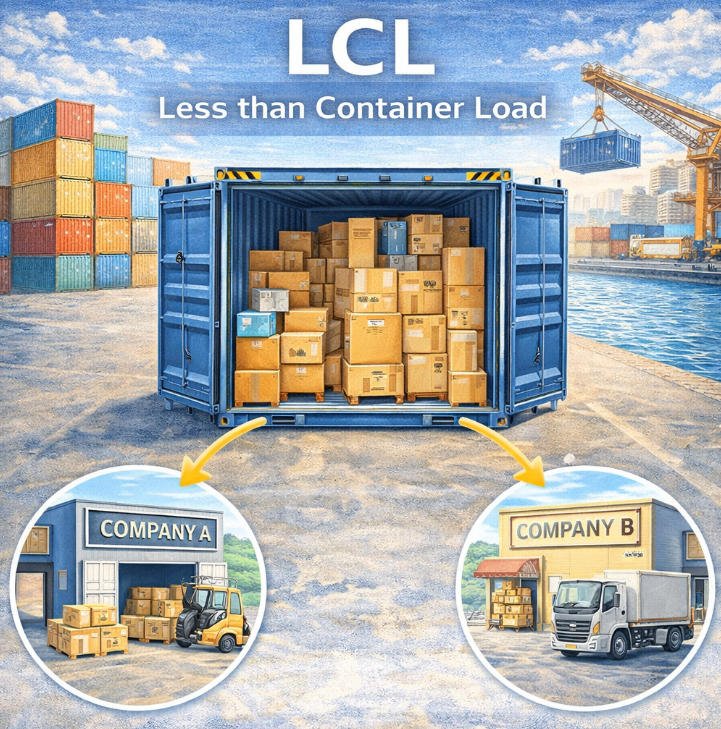
Simply put:
- Full Container Load (FCL) = One customer utilizes one container
- Less than Container Load (LCL) = Multiple customers share one container
Advantages of LCL Shipping
With LCL shipping, you only pay for the specific volume of space your cargo occupies, rather than paying the full cost of an entire container.
Reducing the number of individual shipments while increasing shipping frequency translates into lower expenses for inventory storage and warehousing space.
LCL shipping is more affordable than air freight; therefore, if you have the flexibility to wait for your goods to arrive, you can significantly reduce your transportation costs.
When container capacity is limited—such as during peak shipping seasons or other periods of high shipping volume—LCL shipping is often easier to secure and faster to arrange than FCL (Full Container Load) shipping.
Disadvantages of LCL Shipping
- LCL cargo requires loading and unloading from containers, which extends transit times by several days.
- The cost per cubic meter for LCL shipping is higher than that for FCL shipping—sometimes even double.
- Customs clearance delays for other shipments may result in delays for your cargo as well.
- LCL cargo undergoes more frequent handling, which increases the risk of damage to or loss of the goods.
For exports from China to destinations worldwide—including the United States, Europe, the Middle East, and Africa—LCL shipping is a highly established and mature mode of transport.
Difference Between FCL and LCL
Less than Container Load (LCL) shipping serves as an alternative to Full Container Load (FCL) shipping. As the name implies, FCL shipping refers to cargo that occupies an entire container, and therefore does not share container space with other shipments.

LCL vs. FCL Shipping: A Comparison of Advantages
Transit Time: FCL shipping is typically faster to complete for a simple reason: there are fewer transit points involved. Of course, this assumes all other conditions remain equal—such as the availability of both LCL and FCL cargo at the time of loading.
Cargo Size: FCL shipping is generally best suited for larger shipments that can fill a dedicated container (e.g., 7 to 20 pallets). LCL shipping is typically more appropriate for smaller shipments (e.g., just a few pallets).
Cost: For larger cargo volumes—such as 7, 10, or 20 pallets—FCL shipping is more cost-effective, as the fixed costs associated with FCL transport decrease on a per-pallet basis as the number of pallets within the container increases. Conversely, for smaller cargo volumes—such as 3 pallets—LCL shipping is more cost-effective, as you avoid having to pay the full ocean freight charges required for an FCL shipment.
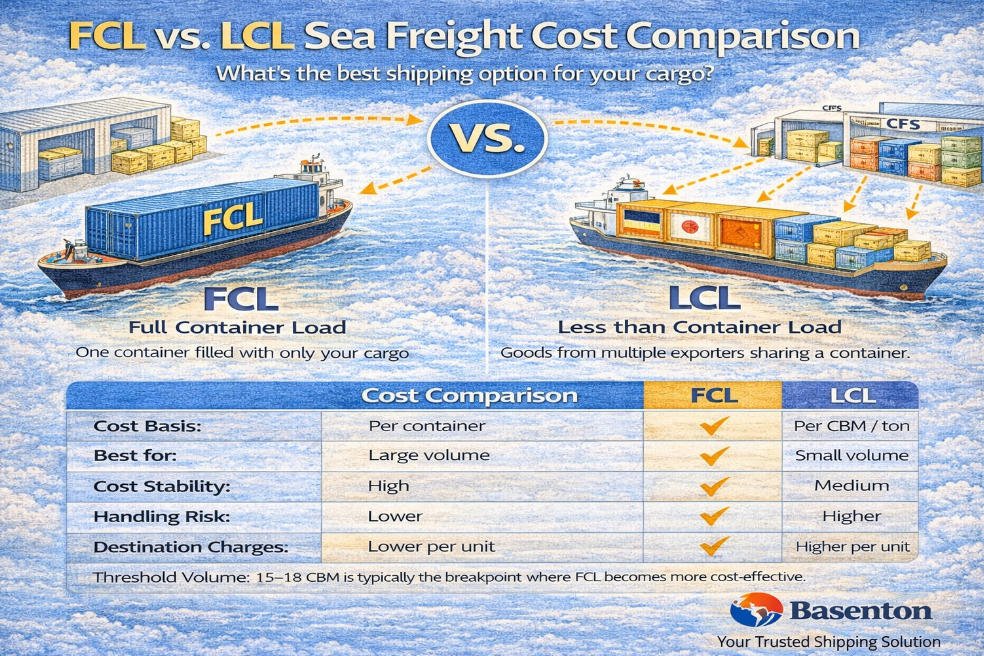
The Meaning of LCL VS FCL Shipping, the Differences and How to Choose
The LCL Shipping Process from China
LCL shipping from China typically involves the following key steps:
- Domestic pickup or delivery from the factory to the Container Freight Station (CFS)
- Export customs clearance
- Container consolidation (combining with other cargo)
- Ocean freight transport
- Deconsolidation at the destination port
- Import customs clearance and final delivery
Compared to FCL (Full Container Load) shipping, LCL involves the additional steps of “consolidation” and “deconsolidation”; this is one of the primary reasons for the higher costs associated with LCL shipments.

How to Transport Dangerous Goods by Sea in LCL
How to Calculate LCL Shipping Costs from China
The cost for Less-than-Container Load (LCL) shipping from China typically ranges from $50 to $150 per cubic meter.
The core principle for calculating LCL charges is as follows:
Charges are calculated based on either volume (CBM) or weight, whichever is greater.
The standard conversion rule is:
1 CBM = 1,000 KG
LCL Cost Calculation Example
Suppose your shipment details are as follows:
- Volume: 3 CBM
- Weight: 2,000 KG
After conversion:
- Based on Volume: 3 CBM
- Based on Weight: 2,000 ÷ 1,000 = 2 CBM
? Select the higher value: Billing is based on 3 CBM.
Breakdown of LCL Shipping Costs (Key Points)
LCL costs consist of more than just the “ocean freight rate of $50 to $150 per cubic meter”; rather, they represent an accumulation of multiple distinct charges:
| Charge Item | Description | Charged Based On |
|---|---|---|
| Ocean Freight | Sea freight cost | Per CBM |
| Origin CFS Fee | Consolidation handling in China | Per CBM |
| Export Clearance | Customs clearance in China | Per shipment |
| Documentation Fee | Bill of lading, paperwork | Per shipment |
| Destination CFS Fee | Deconsolidation at destination | Per CBM |
| Destination Charges | Terminal handling, local fees | Per shipment |
| Delivery Cost | Final delivery (if needed) | Distance / weight |
Why Does LCL Shipping Seem Cheap, Yet Turn Out to Be Costly?
Many clients fall into a common misconception when using Less-than-Container Load (LCL) shipping for the first time:
“LCL is significantly cheaper than shipping a Full Container Load (FCL).”
In reality:
- The unit rate (per CBM) is indeed lower ✔
- However, the total cost is not necessarily lower ❗
The reasons for this are:
- High unpacking and handling fees at the destination port
- Increased operational costs due to multiple loading and unloading stages
- Higher delivery charges compared to FCL shipments
Consequently, when your cargo volume approaches 12–15 CBM, shipping a Full Container Load (FCL) often proves to be the more cost-effective option.
How to Calculate Sea Freight Costs for FCL and LCL Shipments
How to Reduce LCL Shipping Costs?
The following practical methods can effectively lower costs:
- Optimize Packaging: Reduce volume to directly lower costs based on CBM billing.
- Consolidate Shipments: Combine multiple orders into a single shipment.
- Manage Shipping Frequency: Avoid frequent, small-batch shipments.
- Compare FCL Options: When cargo volume approaches that of a full container, prioritize FCL (Full Container Load) shipping.
If you would like to know the costs for LCL shipping from China to various countries, please read:
- Shipping Cost from China to the USA
- Shipping Cost from China to France
- Cost of Shipping from China to Italy
- Shipping Cost from China to Germany
- Shipping Costs from China to the Netherlands
- How much does it cost to ship from China to Spain
- Cost of Shipping from China to Malaysia
- Cost of shipping from China to Japan
- How Much Does it Cost to Ship from China to the Philippines
- Cost of Shipping from China to UAE
- Shipping Cost from China to Saudi Arabia
- How Much is the Shipping Cost from China to Iraq
- How Much does it Cost to Ship from China to Nigeria
- How Much Does it Cost to Ship from China to Kenya
- How Much Does it Cost to Ship from China to Congo
- How Much does it Cost to Ship from China to Turkey
Freight Forwarders for LCL Shipping from China
The cost-effectiveness and efficiency of Less-than-Container Load (LCL) shipping depend largely on the operational capabilities of the freight forwarder.
As a professional freight forwarder based in China, Basenton offers the following services for LCL shipments:
- Access to stable LCL warehouse resources (CFS)
- LCL services across multiple trade lanes (USA, Europe, the Middle East, Africa, etc.)
- A clear and transparent fee structure
- Integrated LCL and delivery solutions
By optimizing LCL strategies, Basenton helps clients effectively control their overall logistics costs while ensuring the stability and reliability of their shipments.
